The Covenant of Grace Through the Bible: A Reformed Explanation of God’s Plan of Salvation
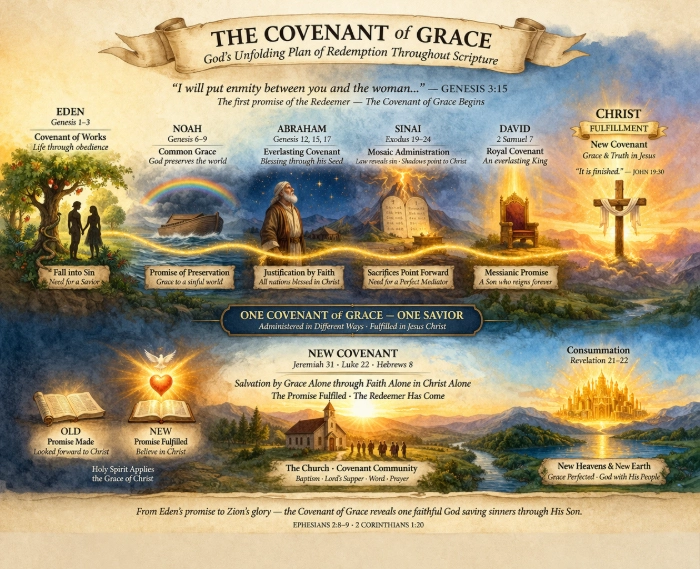
The Covenant of Grace Through the Bible
The covenant of grace is one of the most central and unifying doctrines in Reformed theology because it explains how God saves sinners throughout the entire history of redemption. From the moment humanity fell into sin, God revealed His gracious purpose to restore His people through a promised Redeemer. The covenant of grace is not a single moment in history but the unfolding of God’s saving plan across the whole Bible, progressively revealed and ultimately fulfilled in Jesus Christ.
In Reformed theology, the covenant of grace begins immediately after the fall of Adam and Eve. When sin entered the world, humanity became spiritually dead and incapable of restoring fellowship with God through personal effort or obedience. Yet in Genesis 3:15, often called the “first gospel” or protoevangelium, God promised that the seed of the woman would crush the serpent’s head. This promise marked the beginning of the covenant of grace, revealing that salvation would come through divine initiative rather than human merit.
As redemptive history progresses, the covenant of grace becomes more clearly defined through God’s covenants with key figures in Scripture. In the covenant with Noah, God demonstrates His preserving grace toward the entire creation. Though humanity remains sinful, God restrains judgment and sustains the world so that His redemptive purposes can unfold. This covenant establishes the stability of the created order and provides the stage upon which the drama of salvation continues.
The covenant with Abraham brings further clarity to the covenant of grace. In Genesis 12 and 15, God promises Abraham a great nation, a land, and above all, that through his offspring all the families of the earth will be blessed. The apostle Paul later interprets this promise in Galatians 3, explaining that the true fulfillment of the Abrahamic covenant is found in Christ. Those who belong to Christ by faith are considered Abraham’s offspring and heirs according to promise. This demonstrates that the covenant of grace has always been centered on justification by faith and the inclusion of believers from all nations.
The Mosaic covenant, given at Mount Sinai, plays an important role within the administration of the covenant of grace. While it introduces a detailed legal structure for Israel’s national life, it does not replace the promise of grace previously given to Abraham. Instead, it functions as a temporary arrangement that reveals God’s holiness, exposes human sinfulness, and points forward to the need for a perfect mediator. The sacrificial system, priesthood, and ceremonial laws all serve as shadows that anticipate the coming work of Christ. In this sense, the Mosaic covenant intensifies the awareness of humanity’s need for redemption while preserving the promise of grace.
The covenant with David further advances the unfolding of God’s redemptive plan. In 2 Samuel 7, God promises that a descendant of David will reign forever. This royal covenant strengthens the expectation of a coming Messiah who will establish a kingdom characterized by righteousness and peace. The prophets later build upon this promise, foretelling a future age in which God will renew His people and write His law upon their hearts.
The culmination of the covenant of grace is found in the new covenant established through the life, death, and resurrection of Jesus Christ. At the Last Supper, Jesus declares that His blood is the blood of the new covenant, poured out for the forgiveness of sins. Through His perfect obedience and sacrificial death, Christ accomplishes what all previous covenant administrations pointed toward. He fulfills the promises made to Abraham, embodies the true obedience required under the law, and secures the eternal kingdom promised to David.
In the new covenant era, the blessings of the covenant of grace are applied through the work of the Holy Spirit. Believers are united to Christ, forgiven of their sins, and granted new hearts that desire to follow God’s will. The church becomes the covenant community in which the gospel is proclaimed and the signs of the covenant — baptism and the Lord’s Supper — testify to the reality of salvation accomplished by Christ.
A key emphasis in Reformed theology is that there is fundamentally one covenant of grace administered in different ways throughout biblical history. Though the outward forms change, the substance remains the same: salvation by grace alone through faith alone in Christ alone. Old Testament believers looked forward to the promised Redeemer, while New Testament believers look back to the finished work of Christ. Both are saved on the same basis — the gracious provision of God’s covenant mercy.
Understanding the covenant of grace provides believers with a unified vision of Scripture and a deep assurance of salvation. It demonstrates that God’s redemptive plan is consistent and trustworthy, grounded in His eternal faithfulness rather than in human performance. This doctrine encourages Christians to read the Bible as one unfolding story of grace, centered on Christ and culminating in the restoration of all things.
In summary, the covenant of grace reveals the heart of the gospel throughout the Bible. From the first promise in Eden to the final consummation of the kingdom of God, Scripture testifies to the steadfast love of a covenant-keeping God who saves His people through the person and work of Jesus Christ.