Covenant Theology vs Dispensationalism
Covenant Theology vs Dispensationalism
Few theological discussions shape a believer’s understanding of Scripture more significantly than the distinction between covenant theology and dispensationalism. Both systems seek to interpret the Bible faithfully and uphold the authority of Scripture, yet they approach the structure of redemptive history in markedly different ways. Understanding these differences can help Christians read the Bible more coherently and appreciate the unity of God’s saving purposes in Christ.
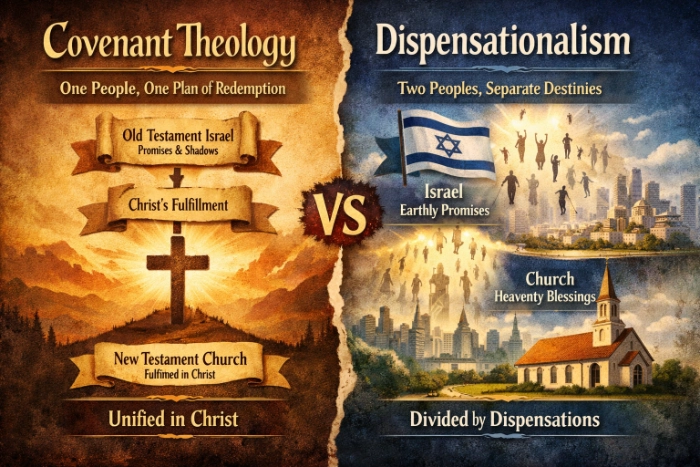
Covenant theology, historically rooted in the Reformed tradition, emphasizes the continuity of God’s plan throughout the entire Bible. It teaches that God relates to humanity through covenants that progressively reveal His redemptive purposes. While there are distinct historical administrations, there is ultimately one overarching covenant of grace through which God saves His people by faith in the promised Messiah. From this perspective, the Old and New Testaments are not separate programs but unified stages in the unfolding story of redemption.
Dispensationalism, on the other hand, developed more recently in church history and tends to divide biblical history into distinct periods, or “dispensations,” in which God administers His will in different ways. Classic dispensational teaching often stresses a stronger distinction between Israel and the church, viewing them as two separate peoples with different roles in God’s plan. In this framework, many of the promises given to national Israel are expected to be fulfilled in a future earthly kingdom, sometimes associated with a literal millennial reign of Christ.
One of the primary differences between the two systems concerns the unity of the people of God. Covenant theology teaches that believers in both the Old and New Testaments are part of the same covenant community. Though the outward forms of worship and administration changed, salvation has always been by grace through faith in the promised Redeemer. Abraham, David, the prophets, and New Testament believers alike are united in Christ as members of one spiritual family. This perspective is supported by passages such as Galatians 3, which describes those who belong to Christ as Abraham’s true offspring and heirs according to promise.
Dispensationalism, particularly in its classical form, tends to emphasize discontinuity. It often maintains that Israel retains a distinct national identity and prophetic destiny separate from the church. This can lead to a reading of Scripture in which Old Testament promises are interpreted primarily in ethnic or geopolitical terms rather than as finding their ultimate fulfillment in Christ and His kingdom. While many modern dispensationalists acknowledge more continuity than earlier formulations allowed, the system still generally preserves a sharper distinction between Israel and the church than covenant theology does.
Another important difference lies in how each framework understands biblical prophecy and eschatology. Covenant theology typically interprets prophetic promises through a Christ-centered lens, seeing Jesus as the fulfillment of the hopes expressed in the covenants with Abraham, Moses, and David. The kingdom of God is understood as already inaugurated through Christ’s first coming and advancing through the proclamation of the gospel. This perspective often leads to amillennial or postmillennial interpretations of Revelation and other prophetic texts, emphasizing the spiritual reign of Christ rather than expecting a future earthly political kingdom centered in a specific nation.
Dispensationalism, by contrast, often reads prophetic passages in a more strictly literal manner. This can result in expectations of a future restoration of national Israel, a rebuilt temple, and a distinct millennial kingdom following Christ’s return. These interpretive differences influence how believers understand the timeline of end-times events, including discussions surrounding the tribulation and the nature of Christ’s reign.
Despite these contrasts, it is important to recognize that both systems aim to uphold the authority of Scripture and affirm core Christian doctrines such as the deity of Christ, justification by faith, and the necessity of grace. The debate is not primarily about the gospel itself but about the structure of biblical revelation and the relationship between the covenants.
From a Reformed covenant theology perspective, the strength of this framework lies in its emphasis on the unity and coherence of God’s redemptive plan. It encourages believers to read the Bible as one unfolding story centered on Christ rather than as a series of disconnected dispensations. This Christ-centered approach highlights the fulfillment of Old Testament promises in the person and work of Jesus and underscores the continuity of God’s covenant faithfulness across generations.
Understanding the differences between covenant theology and dispensationalism ultimately helps Christians interpret Scripture more thoughtfully and appreciate the richness of biblical theology. By seeing how God’s covenants progressively reveal His saving purposes, believers gain a deeper confidence in the reliability of His promises and a clearer vision of the kingdom that Christ has inaugurated and will one day bring to its glorious completion.